System Description
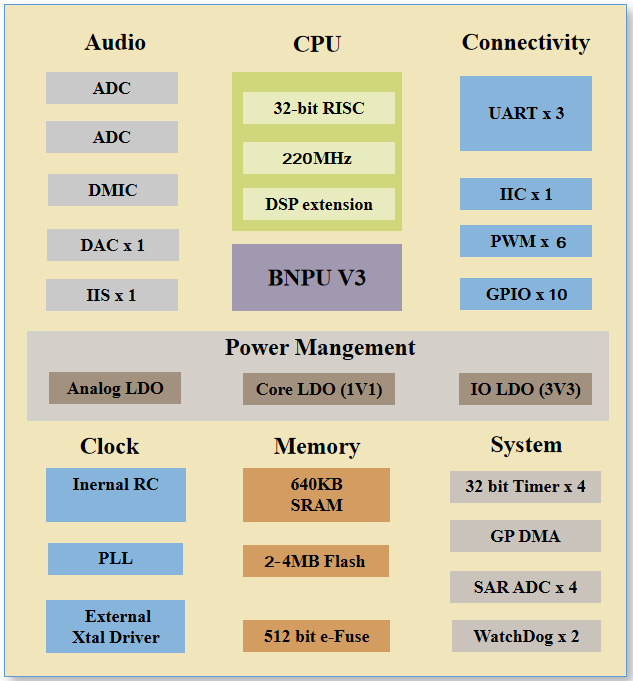
The system block diagram of the CI1301/CI1302/CI1303 chips is shown in Figure S-1. The chips share identical functional interfaces, differing only in built-in Flash size (1MB/2MB/4MB respectively). Each module is described below.
System Architecture
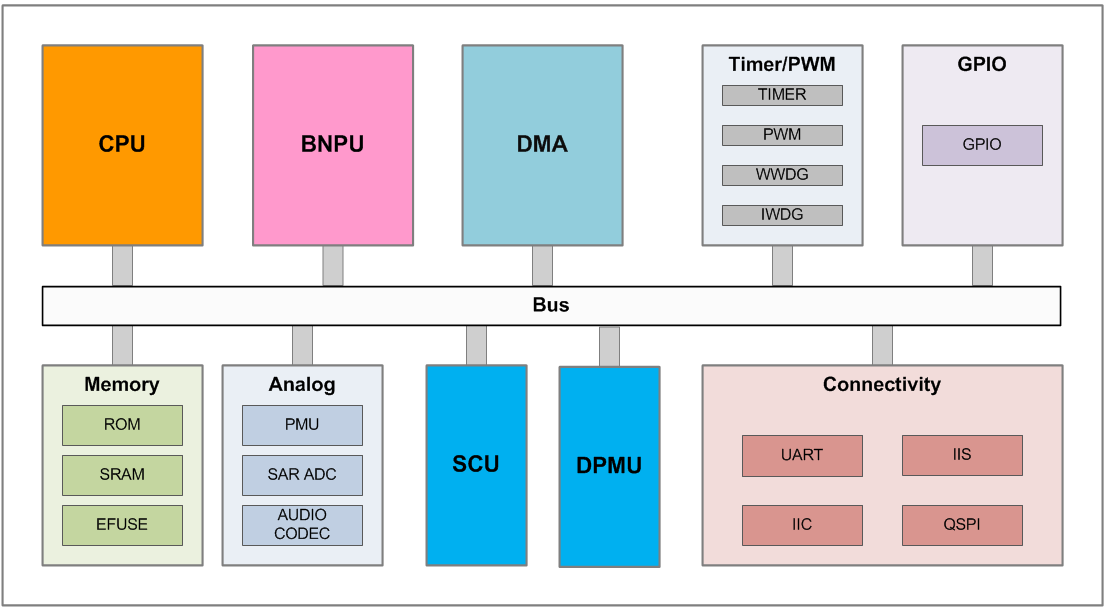
The chip system includes BNPU, CPU, ROM, SRAM, DMA, and various peripheral interfaces. Each functional module communicates and controls through the system bus supporting multi-core parallel processing architecture, as shown in Figure S-2.
Register Mapping
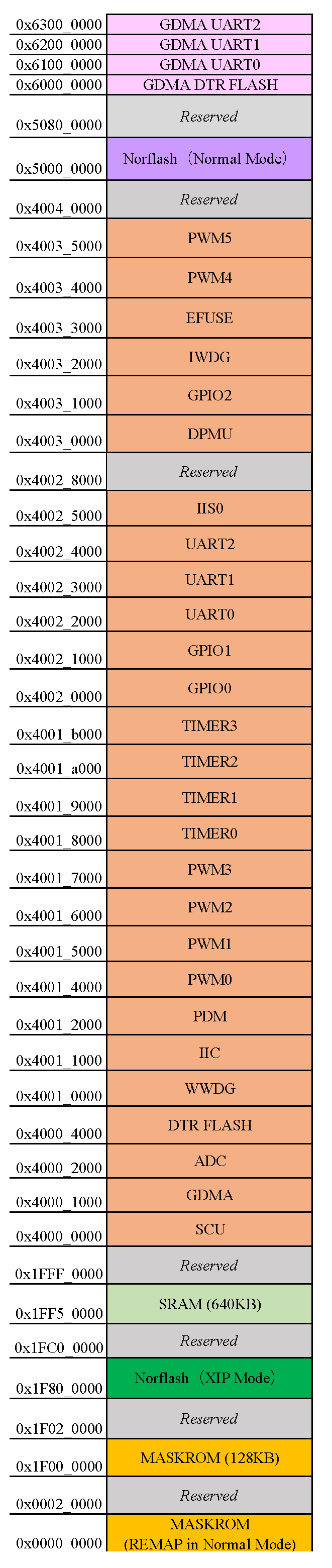
The chip register mapping is shown in Figure S-3, and the internal ROM start address starts from 0x00000000; The starting address of SRAM starts from 0x1FF00000 to 0x1FF7FFFF, totaling 640Kbytes. The rest are the starting addresses of the peripheral interfaces.
Interrupt
With a built-in interrupt controller, the chip supports efficient interrupt handling. Key features include:
- Support software interrupt, timer interrupt and external interrupt;
- 32 programmable external interrupts;
- 3 bits interrupt priority configuration, that is, 8 priority levels;
- Support the software to dynamically and programmatically modify the interrupt level and interrupt priority values;
- Support interrupt nesting based on interrupt level;
- Support fast vector interrupt processing mechanism;
- Support quick tail biting mechanism;
- NMI (Non Maskable Interrupt) is supported.
The interrupt vector table is shown in the following table. After the corresponding interrupt occurs, the CPU will execute instructions from the corresponding interrupt entry address.
| IRQ No. | Interrupt Source | Description |
|---|---|---|
| 0 | INT_WWDG | Window watchdog interrupt |
| 1 | INT_SCU | SCU interrupt |
| 2 | Reserved | Reserved |
| 3 | INT_ADC | ADC controller interrupt |
| 4 | Reserved | Reserved |
| 5 | INT_TIMER0 | Timer 0 interrupt |
| 6 | INT_TIMER1 | Timer 1 interrupt |
| 7 | INT_TIMER2 | Timer 2 interrupt |
| 8 | INT_TIMER3 | Timer 3 interrupt |
| 9 | INT_IIC | IIC interrupt |
| 10 | INT_GPIO0 | GPIO0 interrupt |
| 11 | INT_GPIO1 | GPIO1 interrupt |
| 12 | INT_UART0 | UART0 interrupt |
| 13 | INT_UART1 | UART1 interrupt |
| 14 | INT_UART2 | UART2 interrupt |
| 15 | INT_IIS0 | IIS0 interrupt |
| 16 | Reserved | Reserved |
| 17 | Reserved | Reserved |
| 18 | Reserved | Reserved |
| 19 | Reserved | Reserved |
| 20 | INT_PDM | PDM interrupt |
| 21 | INT_DTR | DTR Flash controller interrupt |
| 22 | Reserved | Reserved |
| 23 | INT_VDT | Low voltage detection indication interrupt |
| 24 | INT_EXT0 | External interrupt 0 |
| 25 | INT_EXT1 | External interrupt 1 |
| 26 | INT_IWDG | Independent watchdog interrupt |
| 27 | Reserved | Reserved |
| 28 | Reserved | Reserved |
| 29 | INT_EFUSE | EFUSE controller interrupt |
| 30 | INT_GPIO2 | GPIO2 interrupt |
Module Overview
This document will describe in detail the modules and registers frequently used by users, as follows:
- System Control Unit (SCU)
- DMA
- Universal Timer and PWM Output
- Independent Watchdog (IWTD)
- Window Watchdog (WWTD)
- DTR_FLASH
- IIC
- IIS
- UART
- GPIO
- ADC
- EFUSE
The configuration and use of other modules, such as BNPU, CODEC, PDM, power management and PLL, EFUSE, have been included in the basic components provided by the CI130X SDK. It is not recommended that users directly modify the driver or directly operate the register to avoid abnormal operation of the basic components. It is recommended to directly use the standard driver interface provided in the CI130X SDK. If you really have special needs, please contact our technical support personnel for support.