Offline Voice+Bluetooth Solution - Communicate with Electronic Control through UART
New users are recommended to check the ☞Beginner’s guide to understand the basic knowledge of development, and then view this document
1 General
Offline voice technology is increasingly being used across various products, adding “ears” and “mouths” that can hear and speak to originally non-intelligent products, thereby enhancing user experience. For the products with Bluetooth control and music playback on the market, our company has added offline voice control function and introduced a set of hardware solutions. This solution employs the voice chip’s UART interface to facilitate communication with the electronic control system Its advantages are as follows:
- Rapid development and verification;
- Flexible application: This method can be flexibly applied to multiple products. Only few modifications to UART and voice command words are needed for different products.
Our company has specially prepared a standard module for this kind of application. The module allows users to bypass the complexities of Bluetooth development and potential issues, ensuring a streamlined process for rapid product deployment.
2 Solution Advantages
At present, our company has iterated multiple generations of chips, holding a strong advantage in the offline voice domain. Key features of our voice solution include:
- Fast recognition response: Typically completes within 0.2 to 0.8 seconds.
- High recognition rate: Over 95% accuracy.
- High reliability: The chip solution has passed rigorous tests such as 85°C/85% RH (Relative Humidity) and EMC tests, meeting the high-quality standards of major appliance manufacturers like Gree and Midea.
- Mature documentation: Comprehensive software, hardware, and structural design documentation is available, helping users save development time and reduce complexity.
- Convenient customization: Our AI platform allows for easy development, enabling quick and flexible customization of wake words and command words without requiring user-provided data.
- Playback interruption: Supports wake-up interruption during Bluetooth music playback (supports AEC functionality).
The Bluetooth features of this solution include:
- Music playback: Supports playing Bluetooth music from phones, tablets, computers, or other devices with Bluetooth media capabilities.
- Call functionality: Supports making calls via Bluetooth voice.
- Mini-program control: Supports Bluetooth wireless control of the product via mobile apps or WeChat mini-programs.
This solution has been widely applied in mass production across various fields, such as fans, heating tables, tea machines, and lighting.
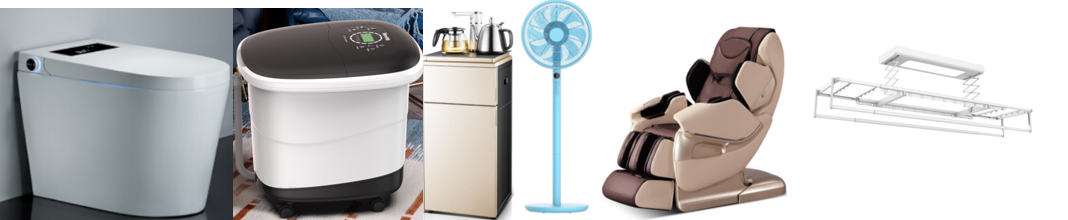
For more information about our chip solutions, please contact us through the following methods.
Tel.: +86-028-61375925 Email: support@Chipintelli.com
3 Application Solution Introduction
If you are first exposed to voice solutions, it is recommended that you first look at the complete product design process ☞product solution development process.
This part focuses on the application block diagram, modules and structure considerations in the solution design.
3.1 Application Block Diagram
The application block diagram of the solution is as follows:
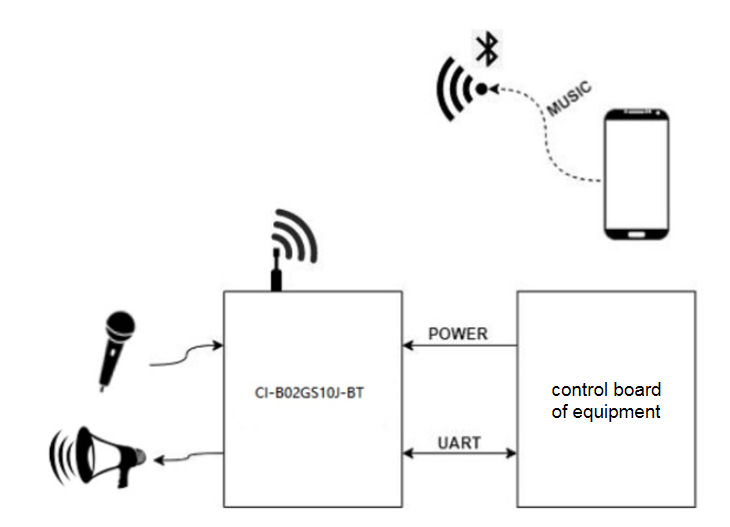
Some precautions in the above figure are as follows:
- Offline control: The voice module and the electronic control module need a four-wire serial connection. The voice module plays audio based on the state of the product’s electronic control, while the product’s inherent control remains managed by the electronic control module;
- Bluetooth play and call: completed by communication between voice chip and Bluetooth chip;
- Mobile phone control: the mobile phone APP or WeChat mini-program sends the information to the electronic control through the voice module, and the electronic control controls the equipment.
The voice module and the electronic control module exchange information through UART. There are two main ways. One is to play the voice module actively and generate the information to the control module at the same time; The other is voice module passive play, which is described as follows:
3.2 UART Communication Mode
Voice Module Active Play
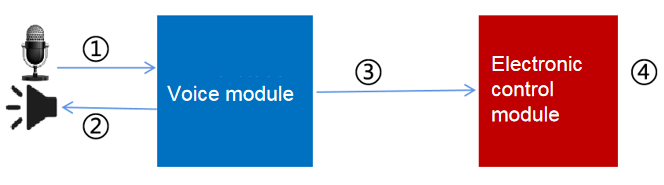
The active play mode mainly performs the following actions:
- Recognize entries;
- Actively play the voice prompt;
- Inform the electronic control module of this message through UART;
- The electronic control module executes actions.
Advantages: simple control mode, one-way output information from voice module to electronic control module.
Disadvantages: It is impossible to give voice prompts according to the current situation of the product and the button controls on the electric control panel.
Voice Module Passive Play
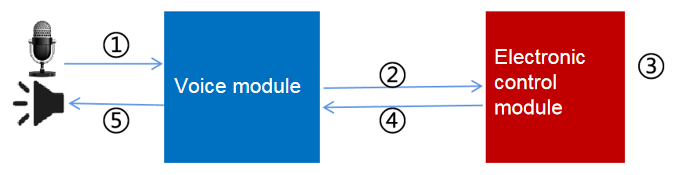
The passive play mode mainly performs the following actions:
- Speech module recognizes voice commands;
- Inform the electronic control module of the voice command information through UART;
- The electronic control module executes relevant actions;
- Inform the voice module of the content to be played through UART;
- The voice module plays voice prompt according to instructions of the electronic control module.
Advantages: The voice module plays the corresponding content according to the status of the electronic control module, which can provide the most appropriate feedback and have a good experience; The electronic control module is controlled by pressing keys or remote control, and the voice module can also play the status.
Disadvantages: The electronic control MCU chip requires a small amount of code development work, and the development cycle is slightly longer than the active play mode.
3.3 Hardware Selection
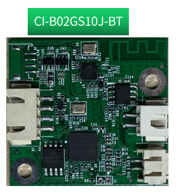
For this solution, our company has several standard modules that can be supported. Users can click ☞Hardware Selection Guide to view and select appropriate modules. Note that the main chips of the standard modules that support this function are CI110X and CI130X. Here are some modules that can be used in this solution, as follows:
From the perspective of rapid development, it is recommended that users directly use the following standard terminal modules of our company. The peripheral applications of the three modules are fully compatible, and the functional differences are as follows:
- CI-B02GS04J-BT2: supports Bluetooth music function; Up and down song switching, pause playing, continue playing, etc;
- CI-B02GS10J-BT: supports Bluetooth music and mini-program control;
- CI-B02GS15J-BT: Support Bluetooth music, mini-program control, Bluetooth call (answering and hanging up, calling and saving contacts).
The following precautions shall be paid attention to in the application of such modules:
- Bluetooth playback demands significant power, so the standard module should have an input power capacity of over 1000mA. If a larger speaker is used, the power supply current should be increased accordingly;
- Module UART operates at 5V level, so a level conversion circuit is not necessary for UART.
3.4 SDK package description and module serial port communication protocol
Our company has provided users with a complete SDK for this solution. Users can go to ☞Chipintelli AI Speech Development Platform. The SDK development kit is: CI110X_BT_sample_SDK_ASR_Offline_V1.5.7-20220520.rar or later.
The communication protocol between the module and Bluetooth has been completed by default, and the user does not need to modify it. It is recommended to use our standard protocol for serial communication between the module and the electronic control. For the specific format, please refer to ☞Serial Protocol.
Note:
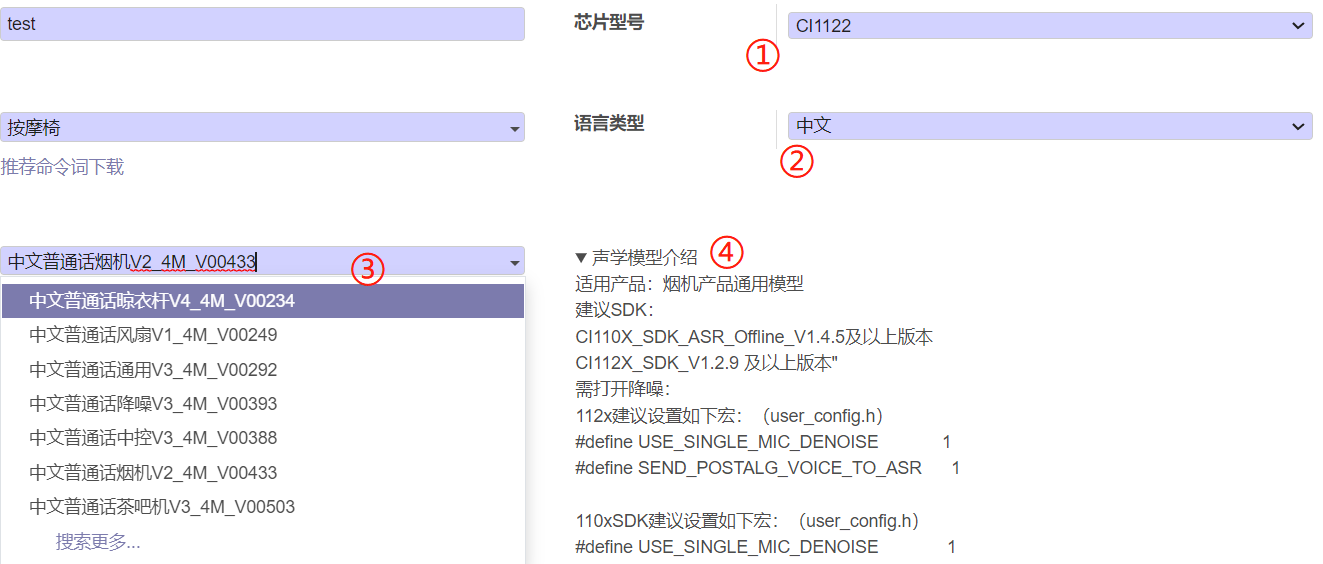
- It is recommended to use different acoustic models in different fields. The details can be seen in the list when making models, as follows: (Note the code configuration suggestions for related models);
- The default parameters of serial communication are: * Baud rate: 9600 * Stop bit: 1 * Data bits: 8 * Parity: None
- What commands and functions are obtained by judging “Command+Voice ID” in the code;
- It is recommended to check the integrity of the sent serial port information.
4 Product Structure
In the offline voice solution, the product structure design is very important, and the location of the microphone and speaker will directly affect the user experience. This part focuses on the structural design of the microphone and speaker to ensure the speech recognition effect of the finished product.
Special attention:
- In order to ensure the recognition effect and AEC interruption effect, the speaker and microphone should be as far away as possible (at least 10CM away) and the situation of the same direction should be reduced;
- If the user does not use our standard module but designs the hardware by himself, please refer to ☞Instructions for Use of Echo Cancellation document in detail to carry out the solution design, and pay attention to the IIS interface reserved on the board. If there is any problem, please contact our company for technical support.
4.1 Precautions for microphone structure design
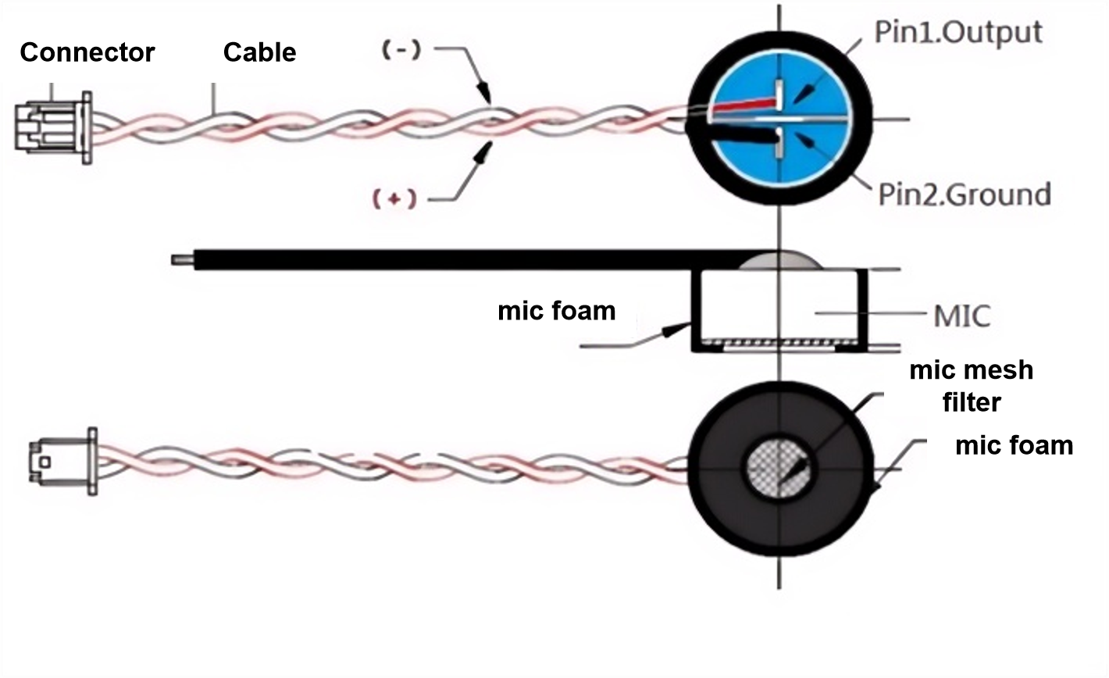
- It is recommended to choose an omnidirectional analog microphone with a signal to noise ratio of more than 70dB and a high cost performance of - 32dB ± 3dB;
- If the vibration of the product is relatively large, select a thicker microphone rubber sleeve to reduce the vibration, which can reduce the impact on the recognition effect;
- In some application scenarios, it is easy to accumulate water or dust, so it is necessary to select a waterproof and dust-proof microphone (provided through communication with the microphone manufacturer);
- The microphone head is a sensitive device, and it is prohibited to directly spot hot sol;
- Insert the microphone completely into the fixing hole to avoid deflection, and align the center hole of the pickup hole with the center of the microphone;
- Select RTV silica gel that meets the environmental RoHS requirements. The recommended common silica gel is 703/704/737, or other organic materials, single component room temperature curing silica gel, etc;
- Most silicone rubber grouts with a thickness of less than 3mm can be cured for 8-12 hours at real temperature, and those with a thickness of more than 3mm can be cured for a longer time, which can be poured in layers for many times to ensure complete curing, stability and sealing;
- The production process can advance the process of fixing the microphone. In addition, pay special attention to the fact that the microphone wiring is pulled by gravity, which may cause the microphone to be pulled askew before it is fully solidified. Also, pay attention to fixing the microphone plug cord.
4.2 Precautions for speaker structure design
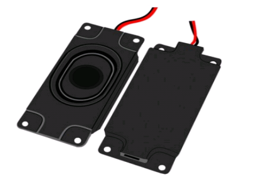
- Considering the sound quality, the speaker power should not be too small. It is recommended to use a speaker of more than 1W. The speaker with a sound cavity will have a better effect. At the same time, note that the power amplifier drive capacity on the hardware board should match the speaker model;
- The speaker is mainly placed in a beautiful and convenient structure layout, but it should be avoided to be placed in the same position with the microphone as far as possible;
- The speaker without sound chamber can be sealed with a sound chamber on the structure to increase the volume output;
- In order to ensure the AEC effect, it is better to choose the speaker with small distortion.
The following figure shows a speaker specification and opening suggestions.
5 List of relevant reference materials
| No. | Reference description | Access method |
|---|---|---|
| 1 | Standard Bluetooth offline SDK CI110X_BT_sample_SDK_ASR_Offline_V1.5.7-20220520 |
Please go to( https://aiplatform.Chipintelli.com){: target=”_blank”} |
| 2 | Selection Guide for Chips and Modules | Please click ☞Hardware Selection Guide to view 3 |
| 3 | Reference of chip hardware design method | Please click the ☞hardware design reference to view |
| 4 | Model selection of microphone and speaker devices | Please click ☞Compatibility list of peripheral devices to view |
| 5 | Product structure design | Please click ☞Product structure design to view |
| 6 | Software development method and standard SDK description | Please click ☞Software development to view the contents of each part |
| 7 | Product speech recognition performance test method | Please click on ☞speech recognition effect test to view |
| 8 | Method of production test | Please click ☞production test to view |
If users encounter problems in use, please submit technical work orders on Chipintelli AI Speech Development Platform, or directly contact our technicians for assistance.