CI-F24XGS01J Module Datasheet
Module Introduction
Overview
This module is a general-purpose, portable, low-power, high-performance voice recognition module designed for cost-effective offline voice applications. The model is CI-F24GS01J, featuring the CI13241/CI13242 main chip, supporting up to 300 offline voice commands (the exact number varies by model).
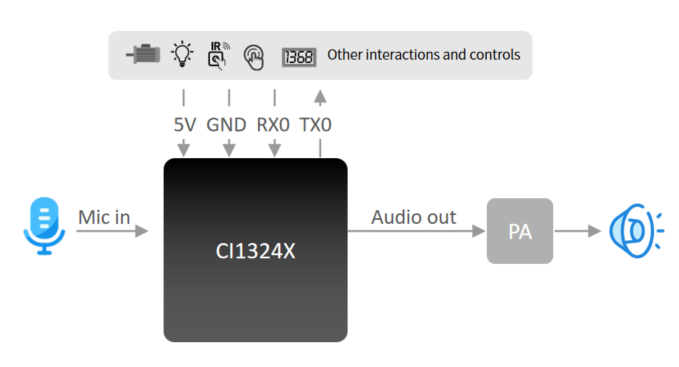
The module features:
Compact size of 30mm × 40mm, operating voltage of 3.6V-5.5V, with onboard power amplifier, one microphone input, one speaker output, and a 5V power/UART interface. The module can be used by simply connecting a microphone, speaker, and power supply. It can also be connected to a main control board via connectors, powered by the main board’s 5V supply, with UART communication or GPIO control, requiring no soldering. The module includes two 3.5mm screw holes for easy mounting and installation.
- The main chip supports offline neural network computing and single-microphone noise reduction enhancement, enabling 360° omnidirectional sound pickup. It can suppress environmental noise to ensure accurate voice recognition in noisy environments. The offline voice recognition doesn’t rely on network connectivity, offering low latency, high performance, over 97% recognition rate, up to 10-meter long-distance recognition, and response times as fast as 0.2 seconds.
- The module can be used in energy-efficient products and battery-powered devices.
- Industrial-grade components ensure high reliability.
| Module Type | Local Commands (≤100) | Local Commands (≤300) |
|---|---|---|
| Single-Mic Offline Voice Module with Connector | CI-F241GS01J | CI-F242GS01J |
Main Chip Introduction
The CI13241 and CI13242 are AI chips specifically designed for voice processing, supporting local voice recognition in multiple languages including Chinese, English, and Japanese. They are widely used in home appliances, lighting, toys, wearables, industrial, automotive, and other fields for voice interaction, control, and various intelligent voice applications.
The CI13241 and CI13242 integrate Chipintelli’s self-developed Brain Neural Network Processor (BNPU V3.5) and CPU core, with a system frequency of up to 210MHz. They feature 288KB SRAM, integrated PMU power management unit, RC oscillator, single-channel high-performance low-power Audio Codec, and multiple peripheral interfaces including UART, I2C, IIS, PWM, GPIO, and PDM. The chips require minimal external components, making them highly cost-effective for various intelligent voice product solutions.
For more details about CI13241 and CI13242 chips, please visit: ☞CI13241&CI13242 Chip Datasheet
Application Scenarios
This module can be used as a voice recognition front-end paired with a customer’s main control board, or as a single-chip solution for lighting, toys, and other applications. It requires an external microphone, speaker, and 5V power supply.
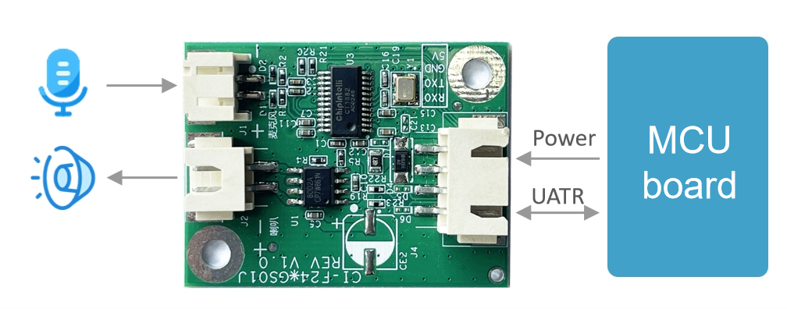
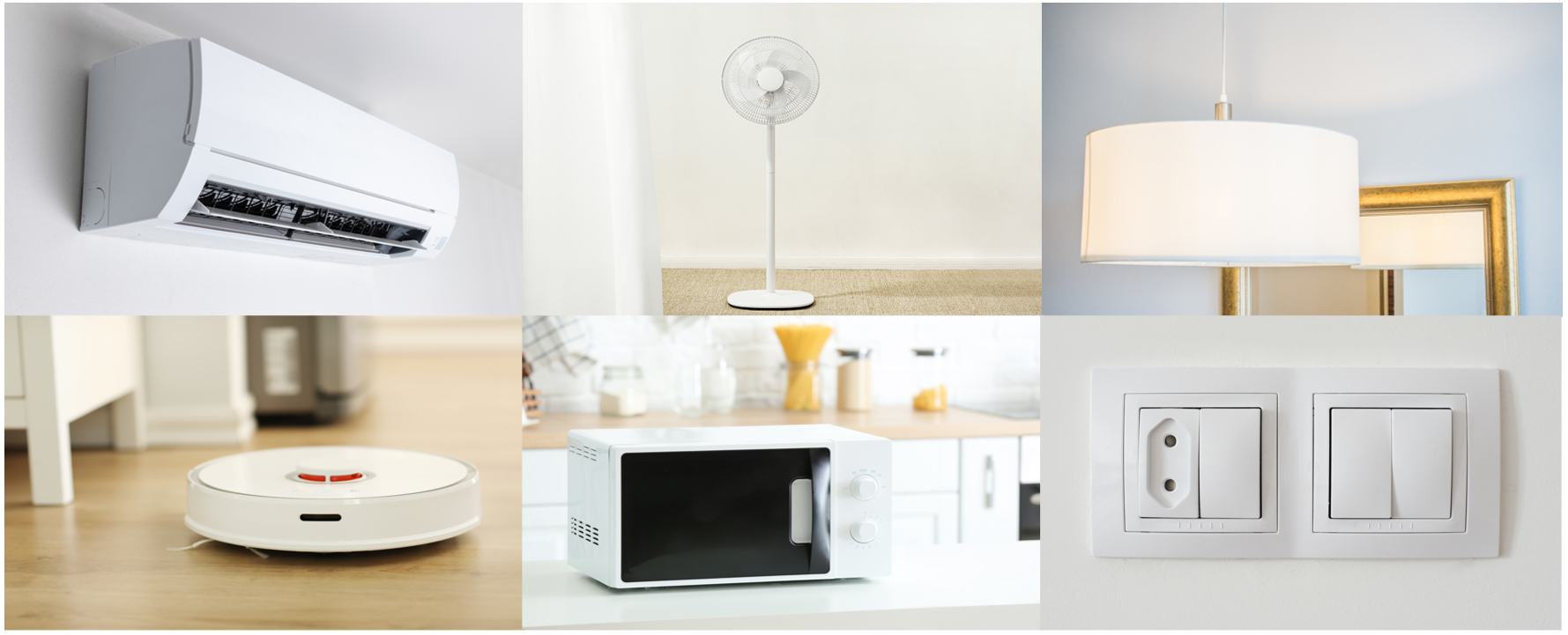
The CI-F242GS01J module supports up to 300 offline voice commands, making it suitable for products with fewer command requirements such as electric fans, heating tables, clothes dryers, small appliances, toys, and lighting.
Module Specifications
Physical Layout
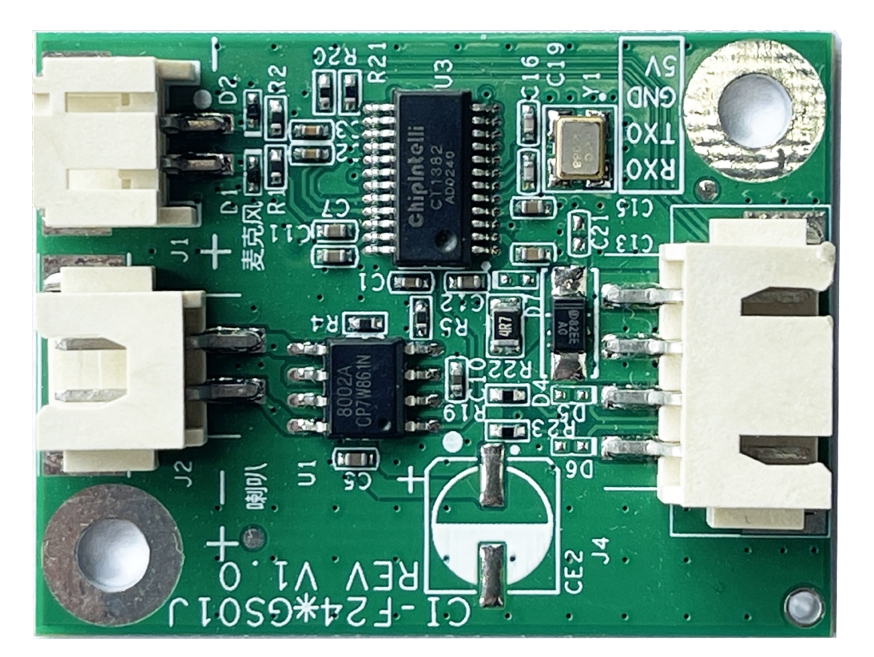
As shown in Figure 4, the voice recognition module features single-sided SMT assembly with the following key components: - Voice recognition chip: CI13242/CI13241 - Power amplifier - Microphone input - Speaker output
Audio is captured by the microphone, processed by the voice IC, and then amplified to drive the speaker. The power amplifier supports up to 1.5W@8Ω and 2W@4Ω output power.
Module Dimensions
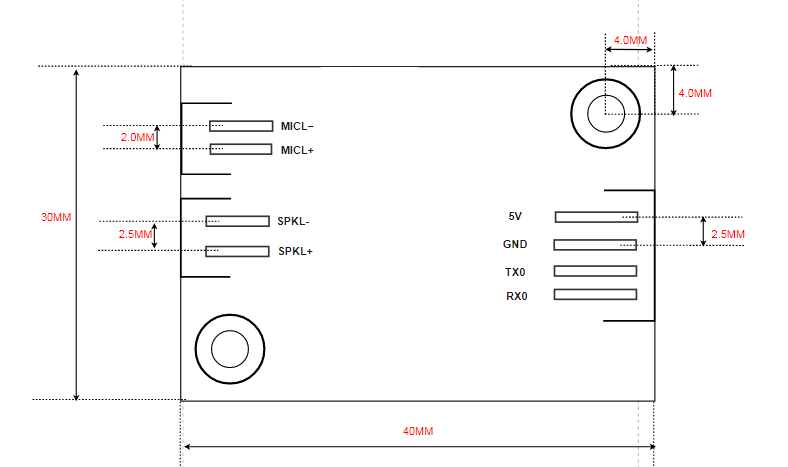
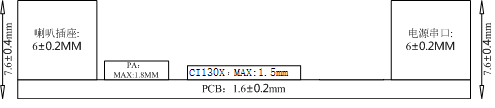
The module has a rectangular shape with the following dimensions: - Length: 30±0.3mm - Width: 40±0.15mm - PCB Thickness: 1.6±0.2mm - Module Height: 7.6±0.4mm
These dimensions should be considered in mechanical designs.
Hardware Interface Definition
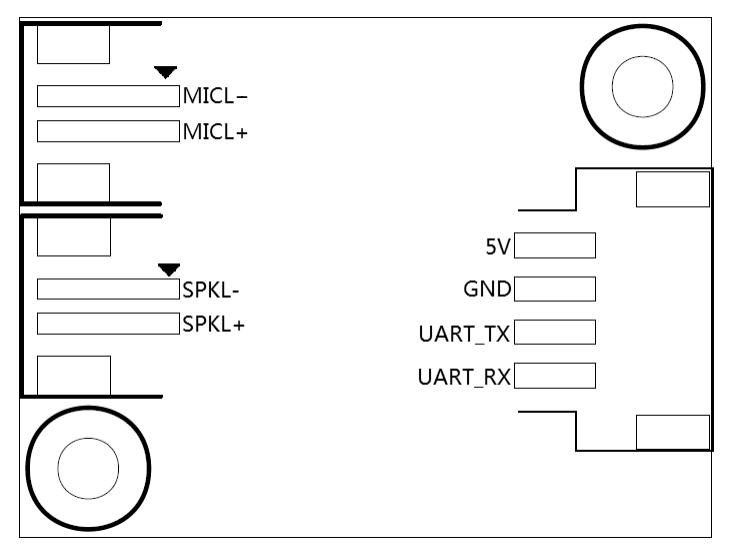
The module includes the following interfaces:
-
Microphone Interface (2-pin, 2.0mm pitch female header) - For optimal recognition, use a microphone with:
- Sensitivity: -32±3dB
- Signal-to-Noise Ratio: ≥65dB
- ☞Compatible Microphone List
-
Speaker Interface (2-pin, 2.5mm pitch female header) - For best audio quality, use a speaker with an acoustic chamber - ☞Compatible Speaker List
-
Power and UART Interface (4-pin, 2.5mm pitch female header) - UART pins can be reconfigured as GPIO if needed - Pin assignments shown in Figure 6
| Pin | Name | I/O Type | Drive Capability | Default State | Function |
|---|---|---|---|---|---|
| 1 | 5V | P | - | - | 5V Power Supply |
| 2 | GND | P | - | - | Ground |
| 3 | UART_TX | IO, T+U | 4mA | IN, T+U | 1. UART0_TX 2. PB5 |
| 4 | UART_RX | IO, T+U | 4mA | IN, T+U | 1. UART0_RX 2. PB6 |
| 5 | MICL- | - | - | - | Microphone Negative |
| 6 | MICL+ | - | - | - | Microphone Positive |
| 7 | SKPL- | - | - | - | Speaker Negative |
| 8 | SKPL+ | - | - | - | Speaker Positive |
Legend: - I: Input - O: Output - IO: Bidirectional - P: Power or Ground - T+D: Tristate with pull-down - T+U: Tristate with pull-up - OUT: Power-on default is output mode - IN: Power-on default is input mode
Electrical Characteristics
| Parameter | Condition | Min | Typ | Max | Unit | Note |
|---|---|---|---|---|---|---|
| Supply Voltage | - | 3.6 | 5 | 5.5 | V | NOTE1 |
| Playback Current (Normal Volume) | 4Ω 3W Speaker | - | 65 | - | mA | NOTE2 |
| Operating Current | - | - | 35 | - | mA | NOTE3 |
| Standby Current (Quiet Mode) | 5V Supply | - | 25 | - | mA | - |
| Chip I/O Voltage | - | 3 | 3.3 | 3.6 | V | - |
| Module UART Voltage | - | 4.5 | 5 | 5.5 | V | - |
NOTE1: 5V is the typical supply voltage. Voltages above 5.5V may damage the module.
NOTE2: The module can draw up to 250mA during audio playback. A power supply capable of 500mA is recommended.
NOTE3: Typical value is measured in mute state. Maximum value is measured during recognition and audio playback.
Temperature and Humidity Specifications
The environmental specifications for the CI-F24GS01J module are shown in Table 4.
| Parameter | Min | Typ | Max | Unit | Note |
|---|---|---|---|---|---|
| Operating Temperature | -40 | 25 | 85 | °C | - |
| Storage Temperature | -40 | 25 | 100 | °C | - |
| Storage Humidity | 0% | - | 5% | RH | - |
Module Application
Power-up and Startup
To use this module:
- Connect the speaker and microphone to their respective interfaces.
- Apply 5V power to the module through the power connector.
- Upon power-up, the module will initialize and play a startup tone through the speaker.
- The UART port will output debug information during startup.
- For monitoring, connect the UART interface to a computer using a USB-to-UART adapter.
- Successful initialization is confirmed when debug messages appear in the serial terminal software (as shown in Figure 7).
Important Notes: - The UART interface operates at 5V logic levels. No level shifting is required when connecting to 5V systems. - The power amplifier requires a stable 5V power supply capable of delivering 500mA. - Power supply ripple must be kept below 300mV for optimal performance.
Default Voice Commands
For production modules, customer-specified voice command firmware is typically pre-loaded before shipment. If no custom commands are specified, the module comes with default firmware containing the following test commands:

The default command set includes common voice control phrases for testing basic functionality. These can be customized according to specific application requirements.
Default UART Communication Protocol
The module’s default firmware includes a UART communication protocol for MCU communication. This protocol is designed with the following features:
- Complete packet structure including: header, length, checksum, message type, and sequence number
- Support for variable-length commands for easy expansion
- Multiple message types (commands, notifications, responses)
- Configurable command messages with ACK responses (notifications do not require ACK)
- Compatible with bootloader upgrade protocol (distinguished by header)
- Default baud rate: 9600 bps
Important Note: The module only provides UART0 interface, which is by default configured for debug output. To use UART0 for the communication protocol, code modifications are required. Refer to the UART protocol section in the ☞CI13LC Series Chip SDK for implementation details.
Supported Commands: - Query protocol version - Query system version - Set volume (volume levels defined in user_config.h) - Play local audio prompts - Reset command
Protocol Format
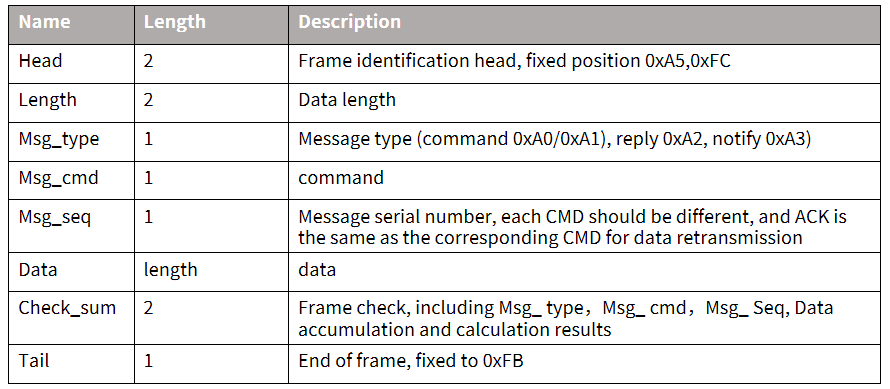
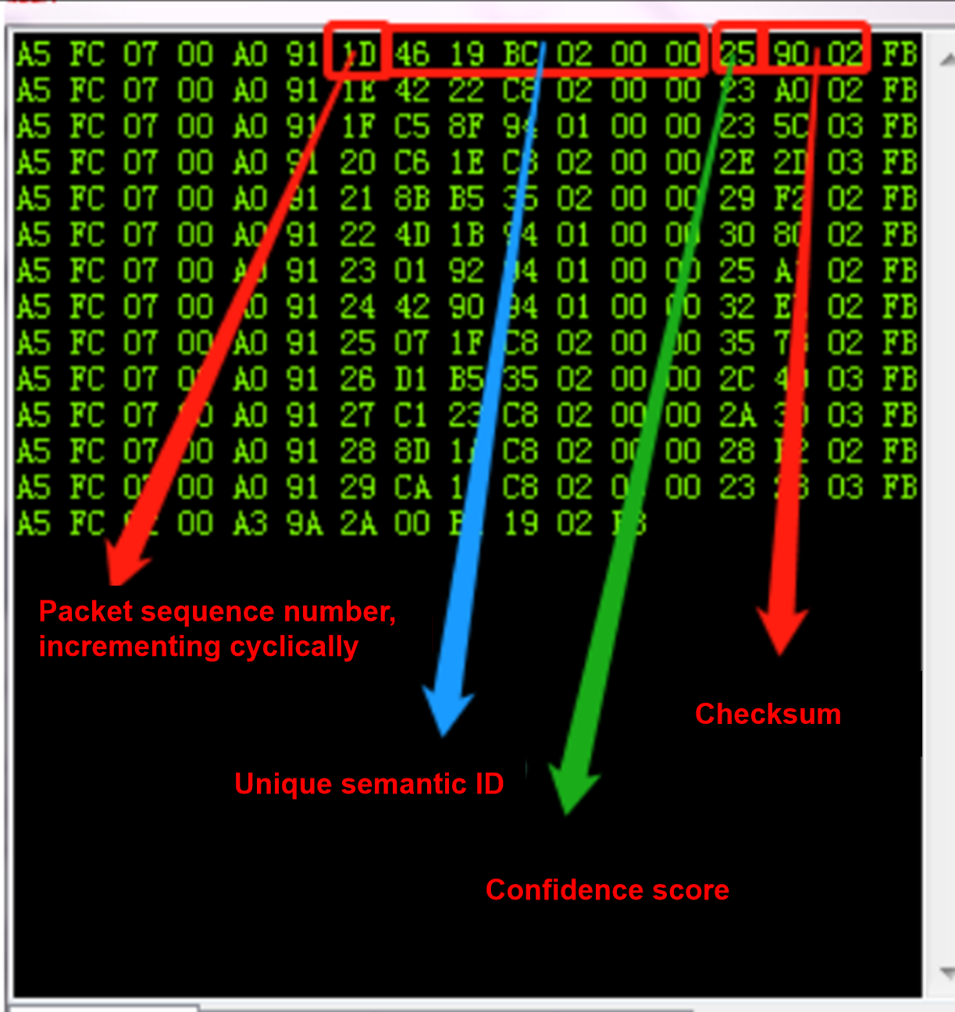
Example 1:
Packet: A5 FC 07 00 A0 91 18 01 55 E0 01 00 00 1B 9B 02 FB
| Field | Value | Description |
|---|---|---|
| Header | A5 FC | Packet start marker |
| Length | 07 00 | 7 bytes of payload |
| Type | A0 | Command word information |
| CMD | 91 | Command code 0x91 (voice command data) |
| Seq | 18 | Packet sequence number (increments with each transmission) |
| Data | 01 55 E0 01 00 00 | Unique command word data |
| Threshold | 1B | Command word threshold |
| Checksum | 9B 02 | Checksum |
| End | FB | Packet end marker |
Note: If only the command word and threshold are needed, focus on the 7 bytes of data highlighted in blue.
Example 2:
Packet: A5 FC 02 00 A3 9A 17 00 B1 05 02 FB
| Field | Value | Description |
|---|---|---|
| Header | A5 FC | Packet start marker |
| Length | 02 00 | 2 bytes of payload |
| Type | A3 | Notification data |
| CMD | 9A | Notification code 0x9A (voice module state change) |
| Seq | 17 | Packet sequence number |
| Data | 00 B1 | Notification data (0x00B1 indicates wake-up state) |
| Checksum | 05 02 | Checksum |
| End | FB | Packet end marker |
Note: This is a notification message. Process according to application requirements.
For more detailed protocol specifications, refer to the UART protocol section in the ☞CI13LC Series Chip SDK.
Software Development
The default firmware included with the module is primarily for initial evaluation. For custom software development, please follow these steps using the Chipintelli AI Speech Development Platform (https://aiplatform.Chipintelli.com):
1. SDK Download
Download the CI13LC Series Chip SDK from the “Development Resources” section of the Chipintelli AI Speech Development Platform. The SDK package includes: - Chip datasheet - SDK development documentation - Development examples - Compilation toolchain - Programming tools - Other necessary hardware resources
2. Create Voice Model
In the “Voice Model” section of the platform: 1. Create a new voice model 2. Select “Offline Voice Recognition” model type 3. Follow the on-screen instructions to complete model creation
3. Voice Synthesis
In the “Voice Synthesis” section: 1. Input the text to be synthesized 2. Select voice characteristics (timbre, speed, volume) 3. Click “Synthesize” to generate the audio file
Firmware flashing
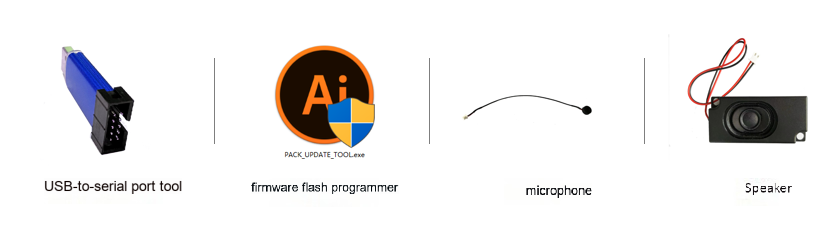
Pre-flashing Preparation
Before flashing firmware to the module, prepare the following items:
- Module to be programmed
- USB-to-UART adapter
- Firmware flashing tool (pack_update_tool.exe)
- Firmware file (*.bin format)
- 2.0mm pitch microphone
- 2.5mm pitch speaker
- DuPont wires
Hardware Connection and flashing Process
-
Connection Setup: - Connect the USB-to-UART adapter to the module as follows:
- USB 5V → Module 5V
- GND → GND
- RXD → Module UART0_TX
- TXD → Module UART0_RX
-
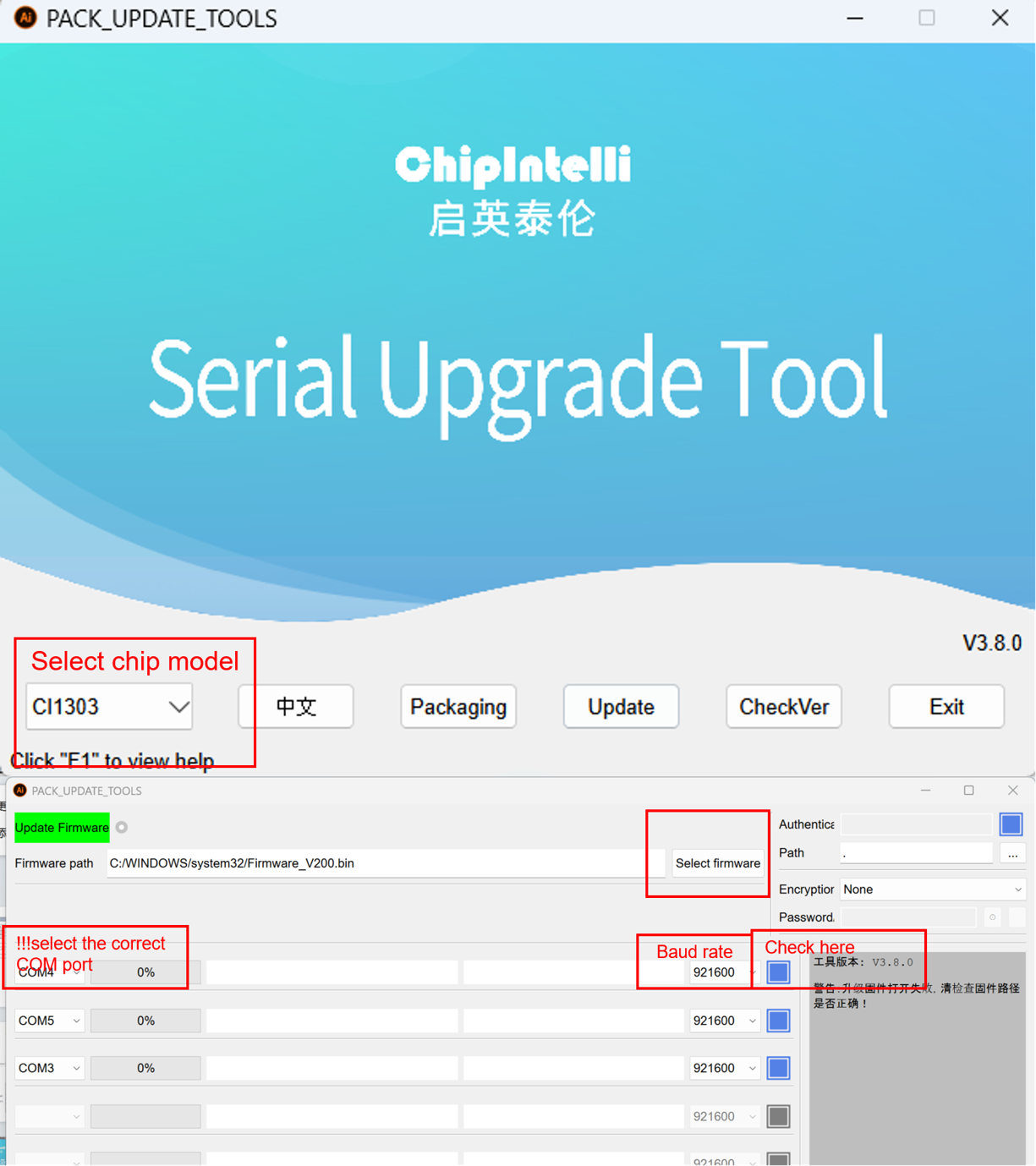
flashing Process: - Open the firmware flashing tool (PACK_UPDATE_TOOL.exe located in the CI13LC_SDK\tools directory) - Select the correct chip model - Click the Firmware Update button - Choose the prepared firmware file (*.bin) - Select the correct COM port assigned to your USB-to-UART adapter - Power cycle the module to enter programming mode - Click “Start” to begin firmware flashing
Note: If the USB-to-UART adapter is not recognized, install the appropriate drivers on your computer.
Post-flashing Functional Test
After successful firmware flashing, perform the following tests to verify functionality:
-
Power-on Test: - Connect the microphone and speaker to the module - Apply power and verify the module plays the startup tone
-
Voice Recognition Test: - Test wake word detection - Verify command word recognition - Check audio feedback for recognized commands
-
Verification: - If all functions work as expected, the firmware flashing was successful - If any issues are found, check connections and repeat the flashing process
Troubleshooting Guide
This section lists common issues that may occur during module usage and their corresponding solutions.
1. Firmware flashing/Update Failure
Symptom: Unable to flash or update firmware to the module.
Troubleshooting Steps:
-
Connection Sequence: - First, connect all necessary cables (TX, RX, GND) - Then select the correct COM port in the flashing tool (refer to Figure 13, item #4) - Finally, apply 5V power
-
Connection Verification: - Verify correct UART pin connections (TX ↔ RX cross-connection) - Check if USB-to-UART adapter drivers are properly installed - Confirm the correct COM port is selected in the flashing tool
-
Power Supply Check: - Using a multimeter, measure the following voltage levels:
- 5V power input
- 3.3V LDO output
- 1.1V core voltage
- Refer to the hardware measurement points in the diagram below
Resolution: - If voltage levels are incorrect or crystal oscillator issues are found, the module may be damaged - If all checks pass but the issue persists, contact Chipintelli technical support
2. No broadcast After flashing
Symptom: Module powers on but produces no sound.
Troubleshooting Steps:
-
Firmware Verification: - Confirm the firmware is compatible with your module version - Verify the firmware was completely and correctly flashed
-
Speaker Connection: - Check speaker connections for proper polarity - Verify speaker impedance matches module requirements - Confirm power supply is stable during operation
-
Signal Measurement: - Use an oscilloscope to measure the audio output test points on the main chip - If no signal is detected:
- Verify firmware correctness
- If signal is present but no sound:
- Check power amplifier connections
- Inspect for soldering issues on the amplifier components
- Test with a known-good speaker
3. Voice Command Recognition Failure
Symptom: Module powers on and produces sound, but does not respond to voice commands.
Troubleshooting Steps:
-
Microphone Connection: - Inspect microphone connections for any loose or broken wires - Verify the microphone is properly seated in its connector
-
Polarity Check: - Confirm microphone polarity matches the board markings - Check for any reversed connections
-
Signal Measurement: - Using a multimeter, measure MICBIAS voltage (should be ~2.8V) - With an oscilloscope (set to 100mV/div):
- Monitor the microphone input pins for audio signal
- Speak into the microphone and observe the waveform
Troubleshooting Flow: - If no MICBIAS voltage: Check power supply and voltage regulators - If MICBIAS is correct but no audio signal: Check microphone and connections - If audio signal present but no recognition: Verify firmware and voice model compatibility
Important Application Notes
-
ESD Protection: - The module features built-in ESD protection at the microphone interface - For applications requiring enhanced ESD protection, additional external ESD protection devices are recommended - Always use proper ESD precautions (wrist straps, gloves) during handling and assembly - Include ESD protection components at connector interfaces on the main PCB
-
Connection Precautions: - Ensure correct connection of microphone, speaker, and power/UART interfaces - Avoid short circuits at test points on the PCB bottom side - The module’s UART interface operates at 5V logic levels - ensure compatible host interface
-
Debugging: - For software debugging, use a USB-to-UART adapter - Add debug print statements in the SDK software as needed - Recompile and flash the firmware after making code changes
Production, Storage, and Ordering Information
Production Guidelines
The module features a foolproof connector design for simplified assembly:
-
Assembly Process: - Insert the three main components into their respective connectors:
- Microphone
- Speaker
- Power/Communication terminal
- Each connector has a unique keying to prevent incorrect insertion
-
Handling Requirements: - Always wear ESD protection (gloves, wrist straps) during handling - Apply firm, even pressure when inserting connectors - Keep modules in vacuum-sealed ESD bags until ready for use - Open ESD packaging only in a controlled ESD-safe environment,and do not open the ESD bag until ready for use
Storage Conditions
- Storage Environment:
- Temperature: < 40°C
- Relative Humidity: < 90% RH (non-condensing)
-
Storage in original vacuum-sealed ESD bags recommended
-
Moisture Sensitivity:
- MSL Level: 3
- After opening the vacuum seal, use within 168 hours (7 days)
Packaging and Ordering
| Model | Packaging | Modules per Tray | Modules per Bag | Modules per Carton |
|---|---|---|---|---|
| CI-F241GS01J CI-F242GS01J |
Tray + ESD Bag + Carton | 40pcs | 400pcs (10 trays) | 1,200pcs (3 bags) |
Purchasing and Technical Support
How to Order
- Samples:
- Order samples directly at Chipintelli Mall
- For bulk orders, contact our sales team
Technical Support
For technical assistance: - Visit our Chipintelli AI Speech Development Platform - Access comprehensive documentation and development resources - Submit support tickets for technical inquiries
Note: Specifications are subject to change without notice. Please refer to the latest version of this document on our website.