CI-G16XGS03T Module Datasheet
Module Introduction
Overview
The CI-G16XGS03T is a versatile, portable, low-power, high-performance voice recognition module with BLE functionality, designed for cost-effective offline voice applications. Model: CI-G16XGS03T, powered by CI23161/CI23162 chips, supports up to 300 offline voice commands (varies by model).
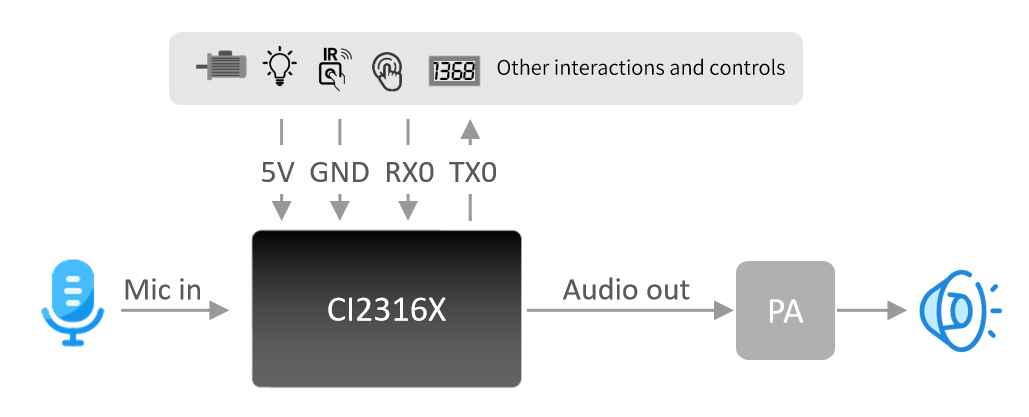
The CI-G16XGS03T module features:
- Excellent recognition performance: Supports offline neural network computing, single-microphone noise reduction, and 360° omnidirectional sound pickup, effectively suppressing environmental noise to ensure accurate voice recognition in noisy environments. The offline voice recognition is network-independent with low latency and high performance, achieving over 97% recognition rate, 10-meter long-distance recognition, and response time as fast as 0.2 seconds.
- Built-in BLE support: The main chip supports Bluetooth BLE, allowing control via WeChat Mini Programs.
- Compact design: Module dimensions: 20.5mm (L) × 19mm (W) × 3.2mm (H) (including shielding cover). Features gold finger design for easy soldering.
- Minimal components: The complete solution requires only an audio power amplifier chip and a few passive components in addition to the voice recognition chip.
- Simple interfaces: One microphone, one speaker, one 5V power supply, and one 5V-level UART communication interface.
- Wide operating voltage: 3.6V to 5V.
- Low power consumption: Suitable for energy-sensitive or battery-powered applications.
- High reliability: All BOM components are industrial-grade.
- Flexible model selection: Choose between CI23161 and CI23162 chips based on the required number of voice commands:
| Module Type | Up to 100 Local Commands | Up to 300 Local Commands |
|---|---|---|
| Gold Finger Offline Voice BLE Module | CI-G161GS03T | CI-G162GS03T |
Main Chip Introduction
The CI23161 and CI23162 are dedicated AI chips for voice processing, supporting local voice recognition and multiple global languages including Chinese, English, and Japanese. They are widely applicable in home appliances, lighting, toys, wearables, industrial, automotive, and other product fields, enabling voice interaction, control, and various intelligent voice solutions.
CI23161 and CI23162 integrate Chipintelli’s self-developed Brain Neural Processing Unit (BNPU) V3.5 and CPU core, with a system frequency up to 210MHz. They feature 288KB of built-in SRAM, integrated PMU power management unit, RC oscillator, single-channel high-performance low-power Audio Codec, and multiple peripheral control interfaces including UART, I2C, PWM, and GPIO. The chips also integrate high-performance, low-power Bluetooth BLE. With minimal external components required, these chips enable cost-effective hardware solutions for various intelligent voice products.
For more detailed information about CI23161 and CI23162 chips, please visit:
☞CI23161&CI23162 Chip Datasheet
Module Application Scenarios
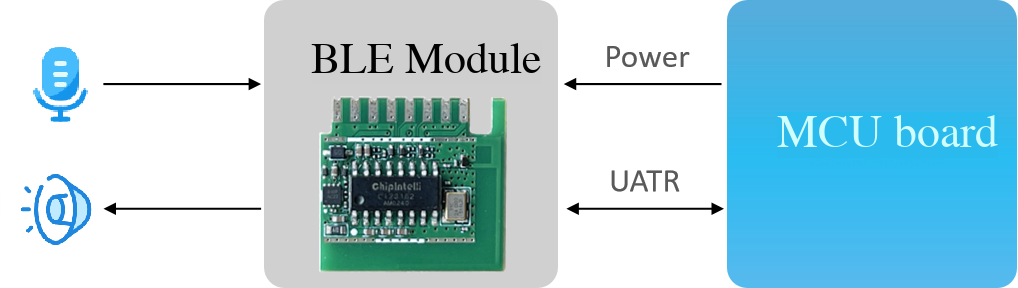
This module can be used as a voice recognition front-end combined with a customer’s main control board, or as a single-chip main control module for lighting, toys, and other solutions. During application, it requires an external microphone, speaker, and 5V power supply.
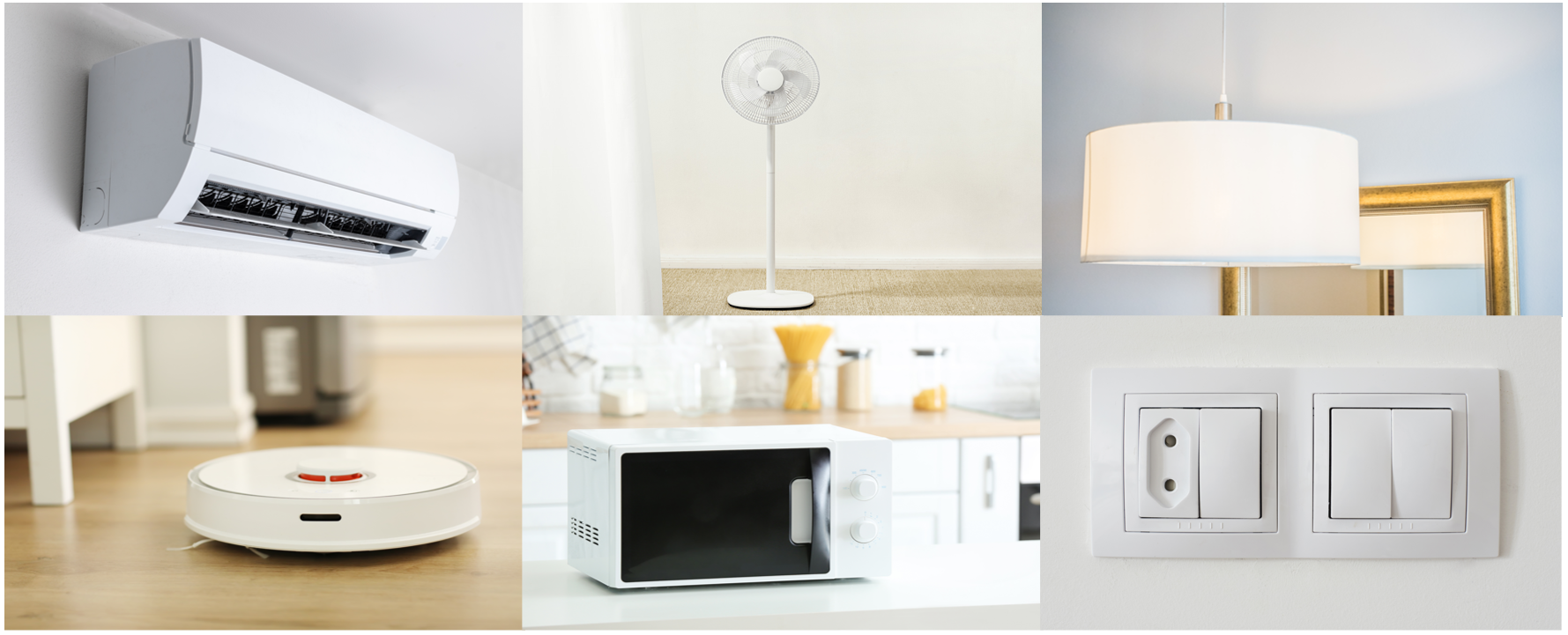
The CI-G16XGS03T series modules support 100-300 offline voice recognition commands depending on the chip, and can be applied to various end products such as smart fans, heating tables, clothes dryers, small household appliances, toys, and lighting.
Module Specifications
Pin Type Definitions
I - Input
O - Output
IO - Bidirectional
P - Power or Ground
T+D - Tristate with pull-down
T+U - Tristate with pull-up
OUT - Power-on defaults to output mode
IN - Power-on defaults to input mode
Module Electrical Characteristics
| Parameter | Condition | Min | Typ | Max | Unit | Note |
|---|---|---|---|---|---|---|
| Module Supply Voltage | / | 3.6 | 5 | 5.5 | V | NOTE1 |
| Module Current in Playback Mode (Normal Volume) | 4Ω 3W Speaker | / | 100 | / | mA | NOTE2 |
| Module Operating Current | / | / | 55 | / | mA | NOTE3 |
| Chip I/O Interface Voltage | / | 3 | 3.3 | 3.6 | V | / |
| Module UART Interface Voltage | / | 4.5 | 5 | 5.5 | V | / |
Notes
NOTE1: 5V is the typical supply voltage. Voltages above 5.5V may damage the module.
NOTE2: The module can draw up to 250mA during audio playback. A power supply capable of 500mA is recommended.
NOTE3: Typical value is measured in mute state. Maximum value is measured during recognition and audio playback.
Bluetooth Electrical Characteristics
| Parameter | Symbol | Description | Min | Typ | Max | Unit |
|---|---|---|---|---|---|---|
| Sleep Power | I_SLEEP | VDDRF=3.3V | - | 6 | - | μA |
| Current in TX 0dBm | I_TX | VDDRF=3.3V | - | 2.5 | - | mA |
| Current in RX 1Mbps BLE | I_RX | VDDRF=3.3V @ -98 dBm sensitivity | - | 2.8 | - | mA |
| Frequency Range | Freq | 2400 | 2483.5 | MHz | ||
| Output Power | Pout | -20 | 5 | dBm |
Module Temperature and Humidity Parameters
The temperature and humidity parameters of CI-G16XGS03T are shown in Table 5.
| Parameter | Min | Typ | Max | Unit | Note |
|---|---|---|---|---|---|
| Operating Temperature | -40 | 25 | 85 | °C | / |
| Storage Temperature | -40 | 25 | 100 | °C | / |
| Storage Humidity | 0% | / | 5% | RH | / |
Module Application
Module Power-On and Startup
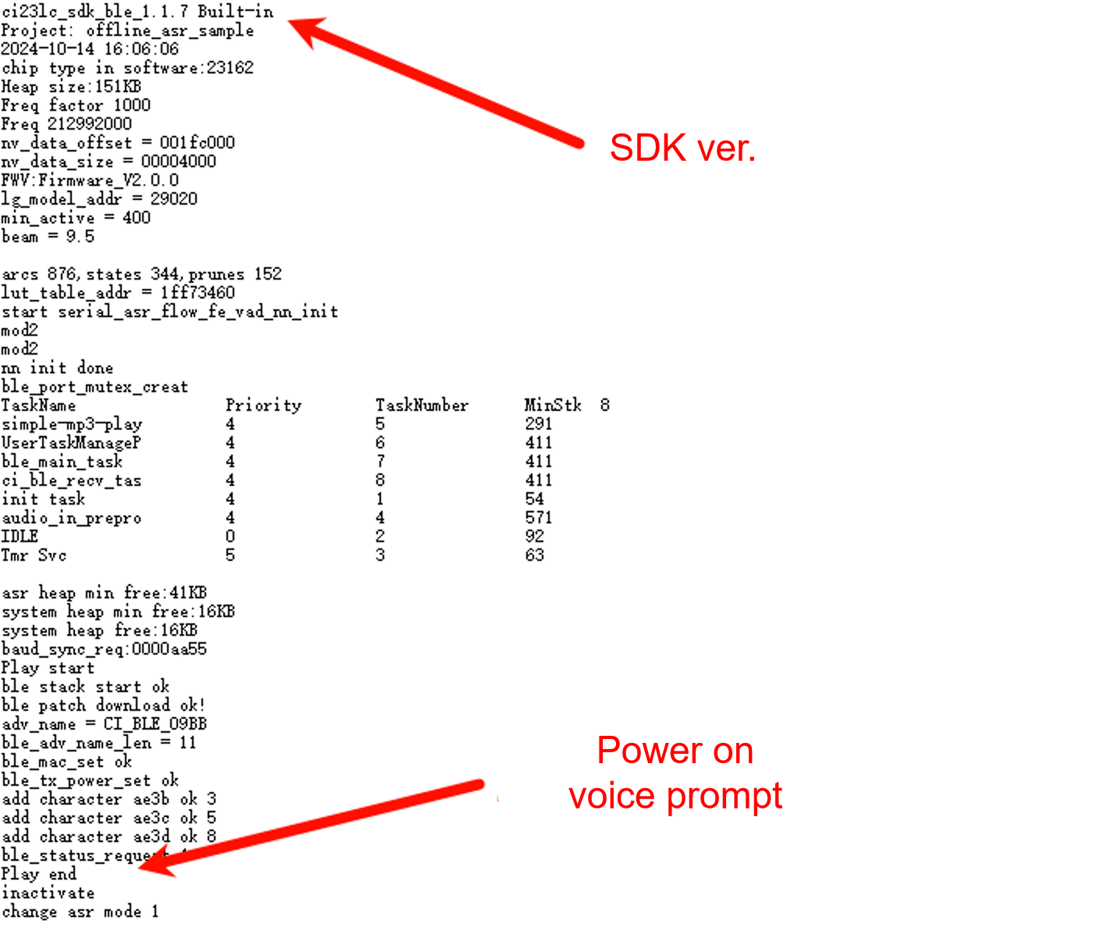
The voice chip and audio power amplifier chip on the module are powered by a 5V power supply. The 5V power supply must provide a rated current of 500mA, with stable voltage and ripple within 300mV.
Module Default Commands
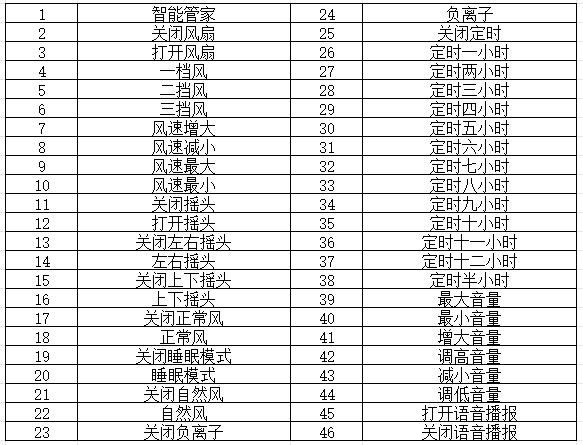
For mass-produced modules, the firmware with user-specified command words is typically pre-installed before leaving the factory. If not specified by the customer, the module comes with default firmware containing preset commands for testing purposes. Some of these default commands are shown in Figure 7 below:
Module Default UART Communication Protocol
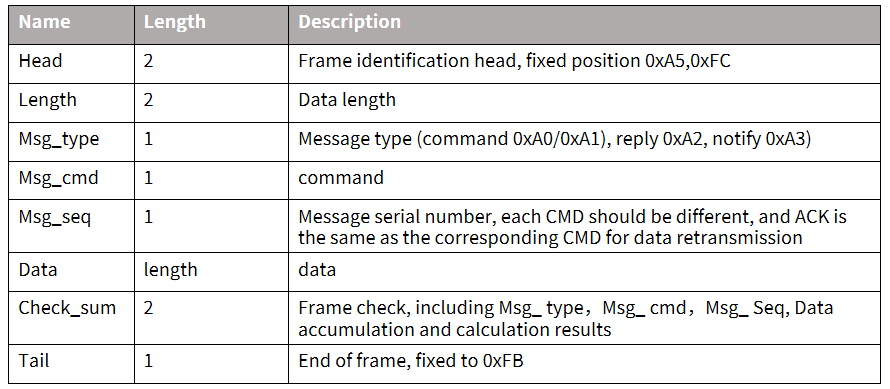
The default firmware of this module supports a UART communication protocol for MCU communication. This UART protocol is extensible and features:
- Complete transmission packets including: header/footer, length, checksum, message type, and message sequence number.
- Supports variable-length commands for easy expansion.
- Message types (commands, notifications, replies).
- Command messages are configurable with ACK replies. Notification messages do not require ACK.
- The message format is the same as that used for bootloader upgrades, differentiated by header from the bootloader protocol.
- Default baud rate: 9600.
- Note: The module only reserves the UART0 interface, which is by default used for print output. To use UART0 as the serial protocol interface, code modifications are required. Refer to the UART protocol section in ☞CI13LC Series Chip SDK for implementation details.
- Supported commands: Query protocol version, query system version, set volume (volume levels defined in user_config.h), play local announcement sounds, reset command, etc. The protocol format is shown in the figure below:
Example 1:
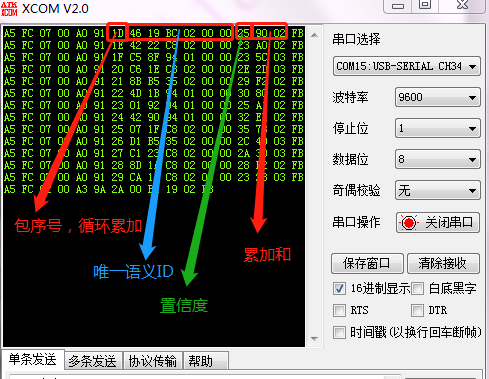
Parsing of A5 FC 07 00 A0 91 18 01 55 E0 01 00 00 1B 9B 02 FB:
A5 FC: Header
07 00: 7 bytes of valid data
A0: Command word information
91: Command number 0x91 (this data contains command word data)
18: Packet sequence number, incremented with each transmission (0x08 for this packet)
01 55 E0 01 00 00: Unique data for the current command word
1B: Command word threshold
9B 02: Checksum
FB: End of data
Note
If only the command words and thresholds are of interest in the application, focus only on the 7 bytes of valid data highlighted in blue.
Example 2:
Parsing of A5 FC 02 00 A3 9A 17 00 B1 05 02 FB:
A5 FC: Header
02 00: 2 bytes of valid data
A3: Notification data
9A: Command number 0x9A (this data contains notification data)
17: Packet sequence number, incremented with each transmission (0x07 for this packet)
00 B1: Valid data (indicates entering wake-up state)
05 02: Checksum
FB: End of data
Note
This data is notification data. Users can choose to use this information as needed.
More data parsing can be found in the UART protocol section of ☞CI13LC Series Chip SDK. The following figure shows a protocol data reference screenshot:
Software Development
The default firmware included with the module is primarily for initial user experience. For software development, users need to register and log in to the Chipintelli AI Speech Development Platform (https://aiplatform.Chipintelli.com) for rapid voice firmware development. The platform’s “Development Resources” section provides access to the SDK and related hardware documentation.
For first-time users of the Chipintelli AI Speech Development Platform, it is recommended to start with the Beginner’s Guide to understand the development process. You can also refer to the Video Tutorials in the documentation center for more solutions and SDK development introductions.
Key features include: * SDK development package download * Model generation(language model + acoustic model) * Voice synthesis * Association of command word information tables with audio files * Firmware packaging
For detailed development procedures, please refer to ☞CI13LC Series Chip SDK.
Firmware Flashing
Pre-flashing Preparation
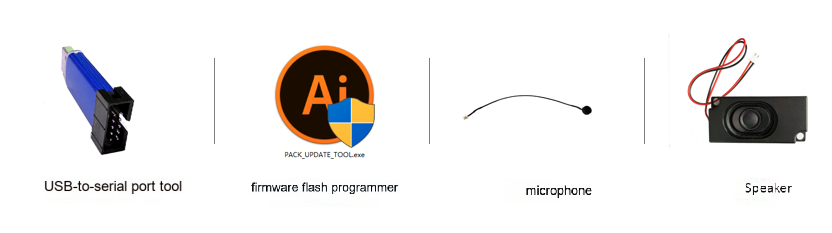
Before flashing the module, prepare the following items:
- Module to be flashed
- USB to UART converter
- Firmware flashing tool (pack_update_tool.exe)
- Firmware file (*.bin format)
- 2.0mm pitch microphone
- 2.5mm pitch speaker
- DuPont wires
Hardware Connection and Flashing
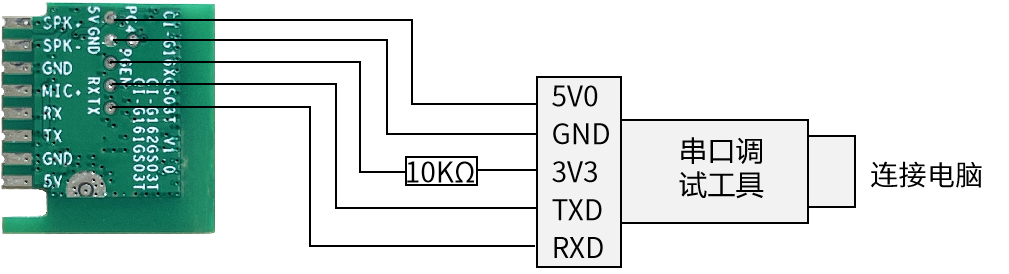
- Hardware Connection: Using the USB to UART converter shown in the figure above, connect the power, ground, and UART communication pins to the corresponding pins on the module before flashing. Note that the RXD and TXD of the USB to UART converter should be connected to UART0_TX and UART0_RX of the module respectively. During flashing, the PGEN pin of the module needs to be pulled up to 3.3V through a 10KΩ resistor, which should be disconnected after flashing. The connection method is shown in the figure below.
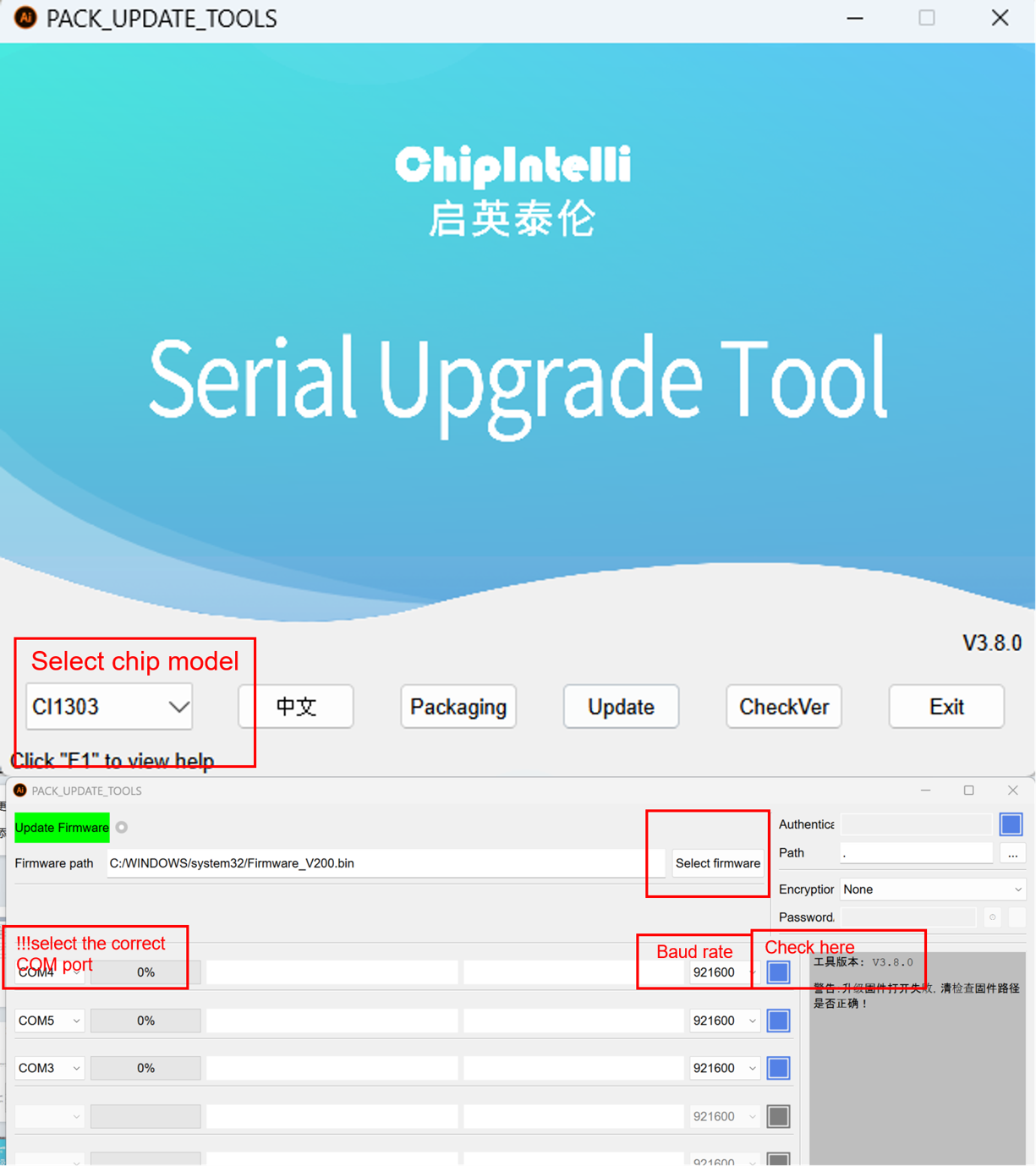
- Firmware Flashing: Open the firmware flashing tool (PACK_UPDATE_TOOL.exe can be found in the CI231X_SDK\tools directory of the SDK development package), select the corresponding chip model, click the Firmware Update button, select the prepared firmware file, and confirm the COM port number assigned to the USB to UART converter by the computer. Once ready, power on the module to enter Firmware Update mode and start downloading the firmware. If the computer cannot recognize the USB to UART converter, please install the corresponding driver first.
Post-flashing Functional Testing
-
Voice Function Test: After firmware flashing is complete, it is recommended to perform functional testing on the module to verify if the firmware was successfully flashed. Before testing, connect the microphone and speaker to the module, power it on to confirm if the power-on announcement is audible, and test if the wake word and command words can be properly recognized. If all functions work correctly, the module is functioning properly and the flashing was successful. Otherwise, the flashing may have failed, and further investigation is needed.
-
Bluetooth Function Test:
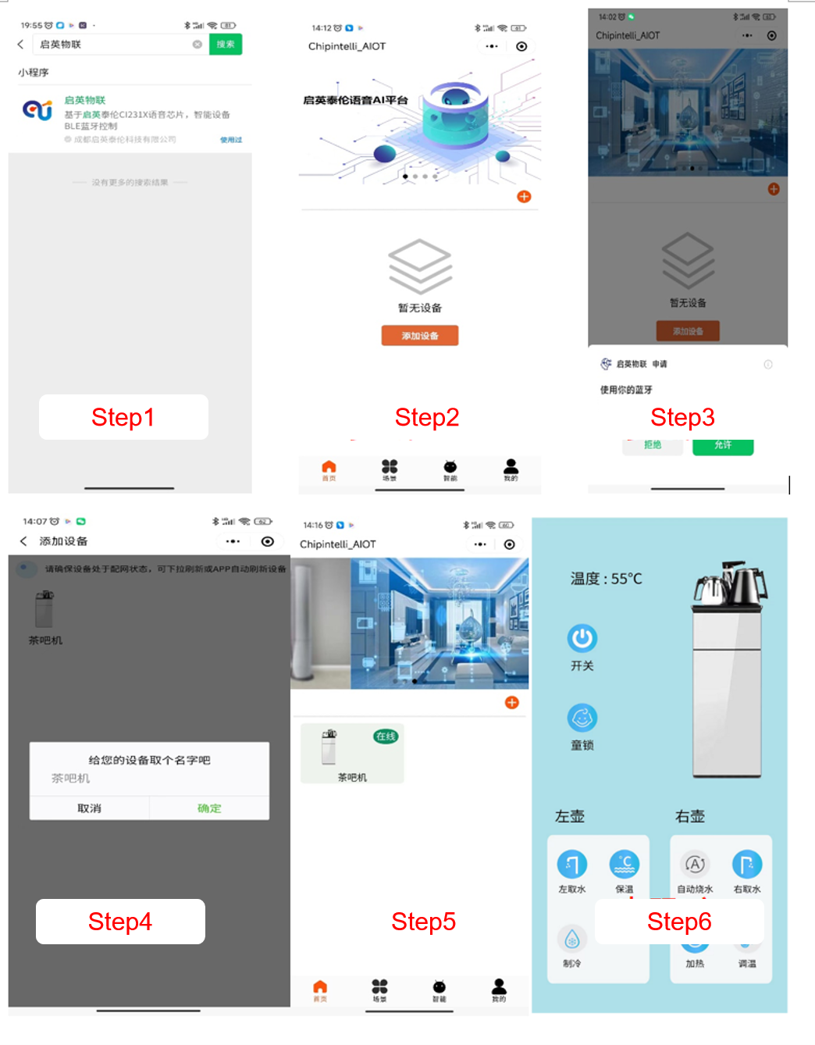
- Search for the “Chipintelli IoT” or “AI Voice Control” mini-program on WeChat
- Enable Bluetooth permissions (some phones may require location permission)
- Turn on the phone’s Bluetooth
- Add a device by clicking the “+” button or the “Add Device” button
- Enter the device scanning interface and click on the detected device (currently supported devices include: tea makers, air conditioners, lights, fans, etc.)
- Confirm device connection
- Name the device
- Return to the home page after successful connection
- Click on the added device to enter the device operation interface
Common Issues
- Flashing Failure
- Check if the module power supply is normal, ensuring the voltage is around 5V with sufficient current capacity.
- Verify if the USB to UART converter is working properly; try changing the USB port or using a different converter.
- Confirm the firmware file is complete and matches the module model.
- Check if all connections are secure, especially the GND connection.
- Voice Recognition Failure
- Verify the microphone is properly connected and functioning.
- Check for excessive environmental noise; testing in a quiet environment is recommended.
- Confirm the firmware includes the correct voice model.
- Inspect the connection between the module and microphone for excessive length or poor contact.
- Bluetooth Connection Issues
- Ensure the phone’s Bluetooth is enabled and the app has necessary permissions.
- Confirm the module is in pairing mode (usually activated by long-pressing a button or automatically on power-up).
- If connection fails, try restarting both the module and the phone’s Bluetooth.
- Check if the distance between the module and phone is too great or if there are obstructions.
- Module Overheating
- Check if the power supply voltage is stable and avoid significant voltage fluctuations.
- Verify the module is operating within the specified temperature range (-40°C to +85°C).
- If the module operates under heavy load for extended periods, consider adding heat dissipation measures.
- Audio Output Abnormalities
- Check if the speaker is properly connected and the impedance matches (typically 4Ω or 8Ω).
- Verify there are no short circuits or poor contacts in the audio output circuit.
- Check if the audio output configuration in the firmware is correct.
Additional Notes
- Module performance may be affected in high temperature, high humidity, or strong electromagnetic interference environments; use in standard conditions is recommended.
- Avoid mechanical shock or vibration to prevent damage to internal components.
- For long-term storage, keep the module in a dry, cool environment away from direct sunlight.
- For further technical support, please contact Chipintelli customer service or visit the Chipintelli official website.
-
Confirm the speaker is properly connected and powered on.
-
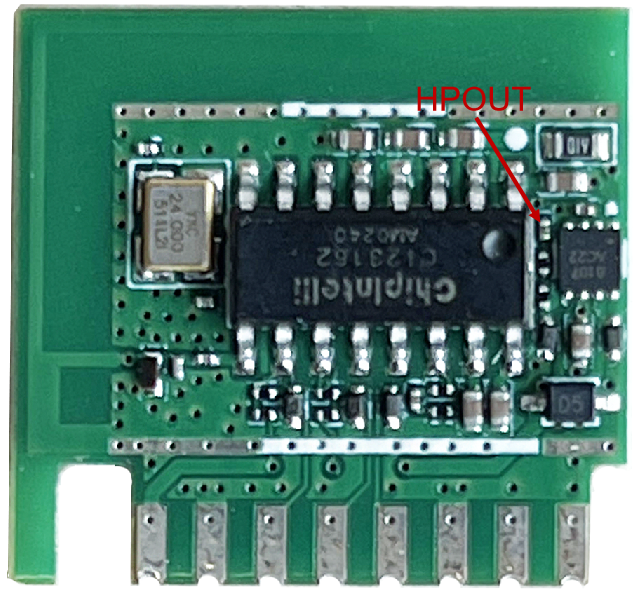
Use an oscilloscope to measure the voice output test points on the main chip. If there is no output, check if the firmware is correct. If there is output but no sound, check for any soldering issues with the audio power amplifier on the module. If the audio amplifier is found to be defective, replace it and test again. The measurement points are shown in the figure below. If all the above checks are normal, please contact our technical support for assistance.
- Module has power-on announcement but does not recognize commands after flashing:
- Check if the microphone and its socket are properly connected.
- Verify that the microphone polarity matches the markings on the module board and is not reversed.
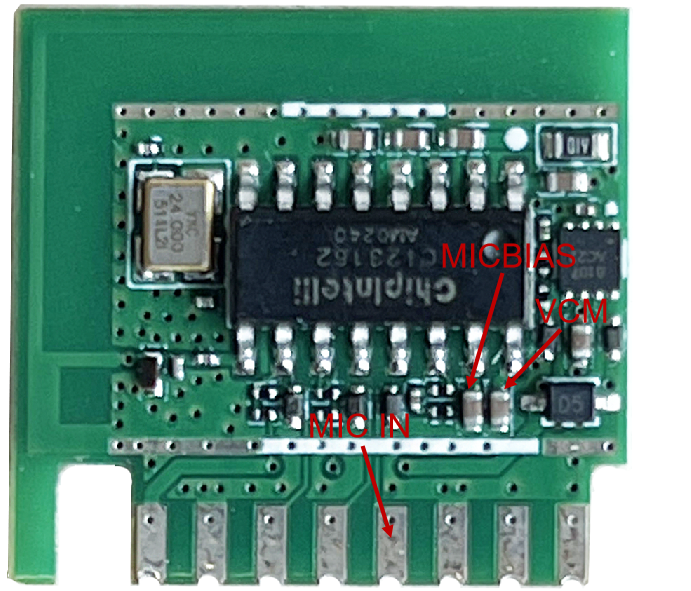
- Use a multimeter to measure if the MICBIAS pin on the main chip has approximately 2.8V. Use an oscilloscope to check for voice input waveforms at the microphone input pins (set the oscilloscope to 100mV per division). If the signal is normal, verify the firmware. If the signal is abnormal, check for any physical damage to the board. The measurement points are shown in the figure below. If all the above checks are normal, please contact our technical support for assistance.
Other Application Notes
-
The CI23161 and CI23162 chips have high ESD protection levels, and the module is designed for easy user expansion. ESD protection devices are only installed at the microphone, speaker, UART, and antenna interfaces. Additional ESD protection can be added for products with higher ESD requirements. It is recommended to wear anti-static wrist straps, gloves, or finger cots during inspection and soldering. Reserve space for ESD protection devices at the corresponding connector positions on the carrier board to ensure product quality and reliability.
-
Do connect the module’s microphone, speaker, power supply, UART, and other interfaces correctly.
-
For software debugging using a USB-to-UART converter, first add UART print commands at the appropriate locations in the SDK program, then compile to generate the firmware and flash it before proceeding with debugging.
-
When designing the carrier board or host motherboard, ensure the module’s 5V power input port is configured with a capacitor of no less than 100uF. Keep the microphone signal traces as short as possible and properly shielded. The speaker (SPK) signal traces should be short and wide, with no other traces crossing over or under the SPK trace area on the PCB.
-
Control the warpage of the carrier board to no more than 0.5% to prevent poor module soldering.
Production Guide, Storage, and Ordering Information
Production and Storage Guidelines
- Storage conditions for CI-G16XGS03T modules:
-
Modules packed in vacuum moisture-proof bags can be stored in environments with temperatures ranging from -40°C to +100°C and relative humidity of 0% to 85% RH.
-
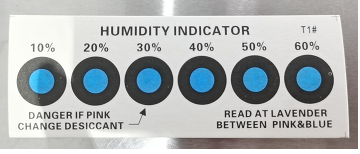
The vacuum moisture-proof bag contains a humidity indicator card as shown below:
- If the humidity indicator card shows the following color changes, bake the modules according to the corresponding parameters:
-
If all three color rings (30%, 40%, 50%) on the humidity indicator card are blue when opening the vacuum bag, bake the modules for 2 hours.
-
If the 30% color ring turns pink, bake the modules for 4 hours.
-
If both 30% and 40% color rings turn pink, bake the modules for 6 hours.
-
If all three color rings (30%, 40%, 50%) turn pink, bake the modules for 12 hours.
- Baking parameters:
-
Baking temperature: 125±5°C
-
Alarm temperature setting: 130°C
-
Number of baking cycles: 1
-
Allow to cool naturally. SMT mounting can proceed after the module temperature drops below 36°C.
-
If the modules are not mounted within 12 hours after baking, they must be baked again.
-
The entire soldering process requires ESD protection for the module. Production operations must wear anti-static gloves/hand rings.
-
To ensure production yield, all soldered modules should be visually inspected, AOI detected, and attention should be paid to temperature control during soldering, the correct adsorption method for the module, and the correct placement method.
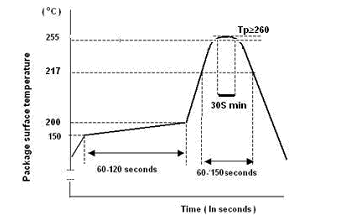
Recommended Reflow Profile
Packaging and Ordering Information
| Product Model | Packaging Method | Modules per tray | Modules per package group | Modules per box |
|---|---|---|---|---|
| CI-G161GS03T CI-G162GS03T |
Tray + Anti-static bag + Carton | 96 pcs/tray | 10 trays, 960pcs in total | 5 bags, 4800pcs in total |
Purchase and Technical Support
If you want to purchase samples of our products, please click ☞Sample Purchase .
If you want to get technical support, please log in to ☞Chipintelli AI Speech Development Platform .