Noise Reduction Development Guide
The noise reduction (DENOISE) algorithm can effectively suppress steady-state noise while maintaining good noise suppression effects with minimal voice distortion. After enabling this feature, recognition performance can be improved by reducing steady-state noise. However, this function consumes 24KB of internal chip storage space and CPU bandwidth resources. This document mainly introduces the applicable scenarios of the noise reduction algorithm and how to enable this feature.
1. Noise Reduction Algorithm
-
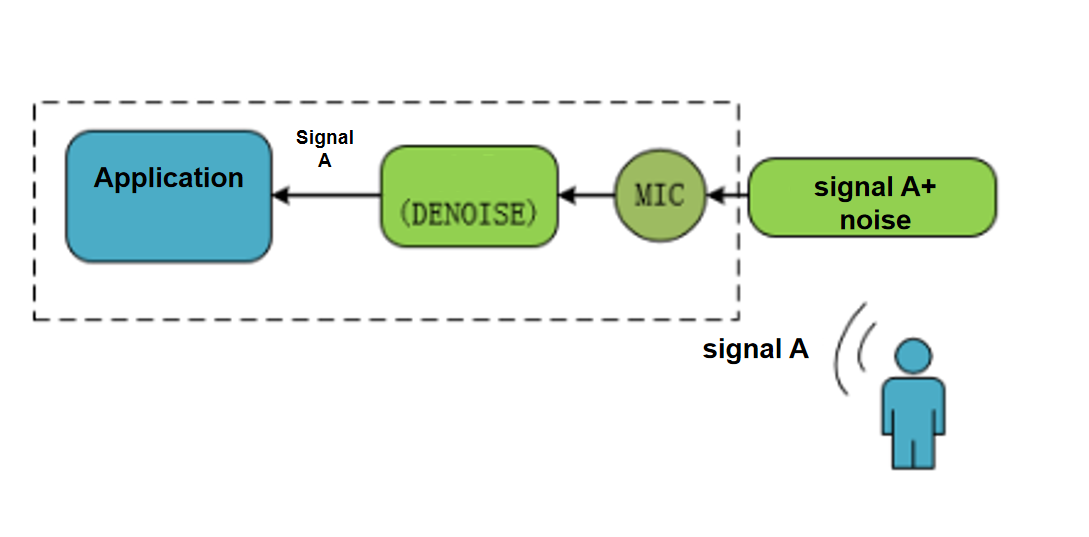
The schematic diagram of the noise reduction algorithm application principle is as follows: human voice is the target voice signal A, noise and signal A are mixed in the application environment and enter the chip. The voice noise reduction algorithm can suppress the noise signal and improve the signal-to-noise ratio of signal A, thereby improving recognition performance.
-
The voice noise reduction algorithm currently provided by ChipIntelli is only suitable for steady-state noise and semi-steady-state noise.
2. Noise Reduction Algorithm Software Configuration
Users can open the ci_ssp_config.c file in the SDK package. The voice noise reduction algorithm has the following parameters available for user debugging:
denoise_config_t denoise_config =
{
    .start_Hz = 0,                        // Noise reduction start frequency in Hz
    .end_Hz = 8000,                       // Noise reduction end frequency in Hz
    .fre_resolution = 31.25f,             // Frequency resolution in Hz: 16000/256
    .aggr_mode = 1,                       // Algorithm processing effect level: 0, 1, 2, processing effect increases sequentially, distortion also increases
    .set_denoise_threshold = 3200,        // Default frame average amplitude >= 3200 takes effect
    .set_denoise_thr_window_size = 20     // Threshold judgment window length
};
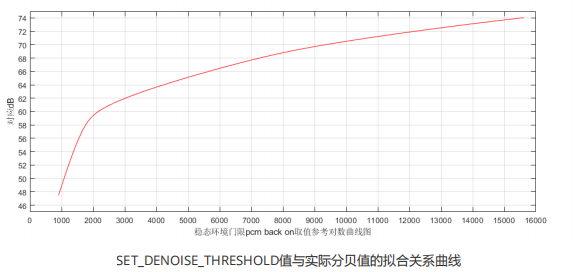
set_denoise_threshold value and the actual decibel value for user reference. The data in the figure often has errors with real measured data. Debugging personnel need to debug according to the actual noise environment to determine whether noise reduction should be performed under current noise conditions.
3. Noise Reduction Algorithm Software Debugging Instructions
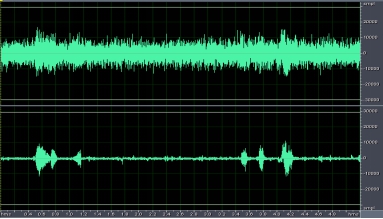
- The following figure shows the comparison effect of time-domain signals after real-time processing. In this figure, you can see the original left channel data (upper half) as a mixture of target voice and noise. After processing by the voice noise reduction algorithm, noise is suppressed and the signal-to-noise ratio of the target voice is improved (lower half).
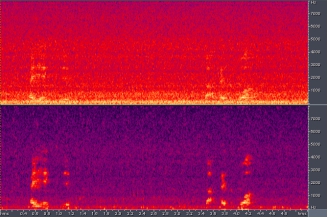
- The following is the frequency domain display of the same audio. This result is normal.